Thursday, 20 April 2023

تشمل الاختبارات الشائعة لتحديد قصور القلب الاحتقاني ومرحلته وسببه ما يلي:

 تشمل الاختبارات الشائعة لتحديد قصور القلب الاحتقاني ومرحلته وسببه ما يلي:


تحاليل الدم.

قسطرة القلب.

الأشعة السينية الصدر.

مخطط صدى القلب.

التصوير بالرنين المغناطيسي للقلب (التصوير بالرنين المغناطيسي).

التصوير المقطعي للقلب (CT).

مخطط كهربية القلب (EKG أو ECG).

مسح التزويد المتعدد (مسح MUGA).

اختبار الإجهاد.

الاختبارات الجينية.

t


Common tests to identify congestive heart failure, its stage and its cause include:


Blood tests.

Cardiac catheterization.

Chest X-ray.

Echocardiogram.

Heart MRI (magnetic resonance imaging).

Cardiac computed tomography (CT).

Electrocardiogram (EKG or ECG).

Multigated Acquisition Scan (MUGA scan).

Stress test.

Genetic testing.


https://go.urtrackinglink.com/aff_c?offer_id=90&aff_id=24051


https://go.urtrackinglink.com/aff_c?offer_id=366&aff_id=24051


https://go.urtrackinglink.com/aff_c?offer_id=1444&aff_id=24051


Friday, 23 September 2022

Case History : A 63 year old female presents to your OPD with complaints of Dizziness, palpitations a A 63 year old female presents to your OPD with complaints of Dizziness, palpitations and apprehension. She also complaints of difficulty in breathing , a dry cough and retro sternal discomfort.

 A 63 year old female presents to your OPD with complaints of Dizziness, palpitations and apprehension. She also complaints of difficulty in breathing , a dry cough and retro sternal discomfort.


Her pulse is 130 beats/ minute and Blood pressure is 145/90 mmHg. Oxygen saturation is 92 percent .


Temperature is 37 C.


Chest is clear on auscultation.


On examination :


She has a goitre visible, mainly in the midline.

There is mild putting oedema of the feet.


An ECG is done, which is shown below:


1. What are the findings in the ECG?


2. What further investigations should be performed?


3. What is the most likely Diagnosis?


4. How should this patient be managed?


Copyright reserved with Author.

Anonymized data with consent taken for teaching purpose.

Answers in comments section.


1. Findings in the ECG:

Irregular R-R interval.

Absent p waves.

Heart rate varying between 110-125 BPM.


2. Further investigation:

Thyroid function Tests

Ultrasound of Thyroid gland and Radio iodine uptake scan if Thyroid function Tests show Thyrotoxicosis.

Chest X rayFull blood countSugar and Cholesterol levelsPro BNP and Echocardiogram.


3. Most Likely Diagnosis

Atrial fibrillation.

Most likely Thyrotoxicosis


4 .Management


Since patients Blood pressure is stable, first line of management would be chemical cardioversion. Medication of choice include:


Bisoprolol 2.5 - 5 mg BD Other options include: Digoxin. and IV Metoprolol 5 mg .


Use Code

ZVN


at these websites for special discount at noon UAE and SAUDIA

https://www.noon.com/uae-en/


https://www.noon.com/saudi-ar/


Use Code


AE21


for websites below for special discountat underarmour uae and saudia 


https://www.underarmour.ae/


https://www.underarmour.sa/


Use code


D1671


for discount at boots Arabia at websites below :


·        

https://www.ae.boots.com/


 ·        


https://www.sa.boots.com/en/        


·        

https://www.kw.boots.com/en/


·        

https://bn.boots.com/en/


·        


·        

https://qt.boots.com/en/


Use Code


OU37


at websites below for Aldakheel

 oud for discounts


https://shop.aldakheeloud.com/


Tuesday, 13 September 2022

A 55 year old lady presents to you with back ache after a fall at home.

 A 55 year old lady presents to you with back ache after a fall at home.


X ray Lumbosacral spine is done that shows partial Sacral S1 fracture , however after seeking an opinion from Neurosurgical and orthopaedics team , they advise mobilize as per pain allows.


You note that on conducting a Full blood count, the results are normal and Electrolytes show her potassium levels are 5.7 mmol/l


Serum Sodium and chloride levels are normal.


Her inflammatory markers and Urea + Creatinine / Renal function tests are normal.


You decide to conduct protein electrophoresis and Urine for Bence Jones proteins / Myeloma screen , but that turns out to be negative as well.


You undertake an ECG that is shown below :


What should be next management step?


Copyright reserved with author.


What should be next management steps ?


This patient has hyperkalemia as can be seen in the blood test where her potassium level is 5.7 mmol/l. ECG also shows typical finding of hyperkalemia which include tall tented t waves.


In order to lower potassium levels , usual management consists of steps below :


Administer Calcium Chloride 10 ml of 10 % over 10 minutes slowly:

This stabilizes the myocardium and prevents against arrhythmias due to hyperkalemia


10 units of insulin Actrapid in 50 ml of 50 % dextrose over 30 minutes :

This will move excess potassium ions into the cells.


Salbutamol nebs 5 mls qds

These can also drive potassium into the cells and help in management of hyperkalemia.


After doing all of the above , you notice her potassium levels become normal , however after 2 days again they become 5.6 mmol/l.

You decide to review her medications and find out she is taking the prescription below :

She has Type 2 Diabetes Mellitus and is on Metformin 1000 mg twice a day for that.

Her BM levels are normal including her HBa1c.

She is taking the following treatment

Doxazosin once a day.

Omeprazole 20 mg once a day

Vit D / Adcal one tablet twice a day.

Paracetamol 1 Gm qds.

Tab Solifenacin 5 mg OD

Which further steps will you take :

The patient is taking 3 medications that can cause hyperkalemia :Metformin :

The patient has stable BM / Blood glucose levels , it might be a good idea to reduce the dose of Metformin to 500 mg once a day and keep monitoring blood glucose levels.


Omeprazole :

Omprazole can cause high potassium levels.

It might be a good idea to substitute Omeprazole with another anti gastritis medication that do not cause high potassium levels such as famotidine.


Doxazosin :

This patient is on Doxazosin which has been started to control her Blood pressure.

It can cause hyperkalemia and hence should be replaced by another medication such as Amlodipine that will not affect her serum potassium levels.


Use Code

ZVN


at these websites for special discount at noon UAE and SAUDIA

https://www.noon.com/uae-en/


https://www.noon.com/saudi-ar/


Use Code


AE21


for websites below for special discountat underarmour uae and saudia 


https://www.underarmour.ae/


https://www.underarmour.sa/


Use code


D1671


for discount at boots Arabia at websites below :


·        

https://www.ae.boots.com/


 ·        


https://www.sa.boots.com/en/        


·        

https://www.kw.boots.com/en/


·        

https://bn.boots.com/en/


·        


·        

https://qt.boots.com/en/


Use Code


OU37


at websites below for Aldakheel oud for discounts


https://shop.aldakheeloud.com/


Dr Gillani at 11:19

Saturday, 3 September 2022

76 year old female presents to your OPD with 3 hours history of weakness of right hand, headache and problem with her vision.

  76 year old female presents to your OPD with 3 hours history of weakness of right hand, headache and problem with her vision.

She also complains of lightheadedness, numbness and tingling on right arm and leg , and difficulty with her speech.

You take her BP which is found to be high at 160/89 mmHg.

She is also having a severe headache that has not responded to analgesics.

You suspect the patient could be having stroke in evolution and decide to order a CT scan of head and ECG and send bloods for further investigations.

Her CT scan is given below:

What are the findings in the CT scan.

Why do you want to conduct/ organize and ECG?

Which bloods should you send?

What is the most likely Diagnosis?

How would you manage this patient?

Copyright reserved with Author.

Answers given in comments section.


1. What are the findings in the CT scan. 

The CT of the head is showing a left occipital infarct. Infarct are visible as dark opacities on CT scan without contrast . 

This is a CT scan without contrast. CT images are conventionally viewed from below,as if looking up into the top of the head. 

This means the right side of the brain is on the left side of the viewer. So as you look at the axial CT images, your left is the patients right side. 

So the right side of the image depicts the left side of the patient. Hence in this case , the occipital appears to be on the right side of the viewer but actually its showing the left side of patient , so the Occipital infarct is on the left side of the patients brain.


2. Why do you want to conduct/ organize and ECG? 

We need to mak sure the patient is not having a disturbed / irregular rhythm / atrial fibrillation as it can lead to development of cardiac thrombi and lead to stroke / cerebral infarcts.


3. Which bloods should you send? 

It is vital to determine underlying cause of stroke , most common on which include cardiac causes, diabetes mellitus, 

Hyoercholesterolemia and hypertension. 

Bloods should be sent for Full blood count , CRP ( to determine underlying sepsis ) sugar levels , Lipid profile, urea, creatinine, and clotting profile , INR < PT , APTT , Proteic C and S levels , Factor V leiden mutations to exclude pro thrombotic diseases and lups antic coagulant. Other investigations.


4. What is the most likely Diagnosis? 

Most likely diagnosis is acute occipital infarct / CVA


5. How would you manage this patient? 


Since it has been less than 4.5 hours and patient is developing an acute infarct , she should be managed by thrombolysis once exclusions of haemorrhage on neuro imaging has been done. 


The drug of choice is Alteplase : 


ALTEPLASE DOSING FOR ACUTE ISCHAEMIC STROKE

 0.9mg / kg body weight to maximum of 90mg

 10% total dose should be given as initial iv bolus

 remainder (90%) should be infused iv over 60 mins in 0.9% sodium

chloride (or can be given neat via a syringe pump).

Tuesday, 30 August 2022

Biochemistry : Aldehydes and ketones

 Aldehydes and ketones possess the strongly reducing carbonyl group C=O

Aldehydes have one and ketones have two alkyl groups attached to the carbon bearing the crbonyl group.

The sugars in addition to being polyhydric alcohols are also either aldehydes or ketones.


Aldehyde

Organic compounds containing a functional group with the structure −CHO, consisting of a carbonyl

 center (a carbon double-bonded to oxygen) with the carbon atom also bonded to hydrogen and to an R

 group, which is any generic alkyl or side chain


What are aldehydes in chemistry?

Aldehydes are organic compounds, in which a carbon atom shares a double bond with an oxygen atom, a single bond with a hydrogen atom, and a single bond with another atom or group of atoms (designated R in general chemical formulas and structure diagrams). These compounds help create fragrances for products like perfume, laundry detergent and soap.


Industrial Applications. 

Aldehydes are versatile compounds that can help make resins, dyes and organic acids, as well as perfumes , for cologne, detergents and soaps. Of all aldehydes, formaldehyde is produced industrially on the largest  scale.


Perfumes

Aldehydes are present in many organic materials, everything from rose, citronella, vanilla and orange

 rind. Scientists also can create these compounds synthetically to use as ingredients for sweet-smelling

 perfumes and colognes. 


What are the names of these aldehydes?


1 carbon atom: form -


2 carbon atoms: acet -


3 carbon atoms: propion -


4 carbon atoms: butyr -


Methods of preparation of Aldehydes :


There are several methods for preparing aldehydes,[2] but the dominant technology is hydroformylation

Other Methods include :

Oxidative routes 

Specialty Methods


Reaction name

Ozonolysis

Organic reduction

Rosenmund reaction

Wittig reaction

Formylation reactions

Nef reaction

Kornblum oxidation

Zincke reaction

Stephen aldehyde synthesis

Meyers synthesis

Geminal halide hydrolysis

Hofmann rearrangement

McFadyen-Stevens reaction

Biotransformation

Tuesday, 9 August 2022

Biochemistry Basics : Cis trans isomerism

 Cis trans isomerism


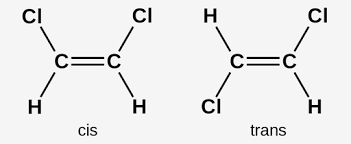
Cis–trans isomerism, also known as geometric isomerism or configurational isomerism, is a term used in chemistry that concerns the spatial arrangement of atoms within molecules. The prefixes "cis" and "trans" are from Latin: "this side of" and "the other side of", respectively.

This occurs in compounds with double bonds.

Since the double bond is rigid , the atoms attached to it are not free to rotate as are those attached to a single bond.

Maleic acid cis

Fumaric acis trans 

These 2 structures are not equivalent and have different chemical and physiological properties.

Fumaric acid but not maleic acid is physiologically active.

The cis isomer / maleic acid has 2 more bulky groups ( COOH) on the same side of the double bond.

If they are on the opposite side of the double bond , a trans isomer is produced.

Introduction of trans double bonds in an otherwise saturated hydrocarbon chain deforms the shape of the molecule relatively little.

A cis double bond by contrast entirely changes its shape.

It can this be appreciated why cis and trans isomers of a compound are not interchangeable in cells.

Membranes  composed  of trans and cis isomers would have entirely different shapes.

Enzymes acting on one isomer would be expected to be entirely inert with the other.

The usual formulas fail to represent the actual shape of the molecules.

Portions of the hydrocarbon backbone of a saturated fatty acid and of the cis and trans isomers of an 18 carbon unsaturated fatty acid are represented in Fig 1-7

Cis-trans isomers exhibit a type of stereoisomerism where the atoms have different spatial arrangements in three-dimensional space. In the field of organic chemistry, cis isomers contain functional groups on the same side of the carbon chain whereas the functional groups are on opposite sides in trans isomers.

Why trans isomers are more stable?

Trans isomer is more stable than cis isomer because in cis isomer, the bulky groups are on the same side of the double bond. The steric repulsion of the groups makes the cis isomer less stable than the trans isomer in which the bulky groups are far apart ( They are on the opposite side of the double bond).


Monday, 8 August 2022

Soil Texture : Inter particle forces

 Soil Texture : Inter particle forces

The interaction of soil particles with other particles is influenced by the following forces :

Weight of the particle Fg

Particle surface forces Fs

Weight is the result of gravitational forces and is function of the volume of the particle.

For equidimensional particles such as spherers of diameyter D , the weight Fg is directly proportional to D3.

Particle surface forces are of an electric nature.

They are caused by un satisfied electrical charges in the particles crystalline structure.

Surface forces F3 are directly proportional to the surface areaand hence for equideimensional particles to D 2

The ratio of weight of a particle to the particle surface forces Fg/Fs is directly proportional to D

Thus for large particle sizes which include soil particles in the coarse fraction > 0.075 mm ,the weight of the particle is predominant over the surface forces.

As the particle diameter decreases , the ratio Fg/Fs decreases thus for very small values of D , the surface forces predominate.

This accounts for cohesive nature of most fine grained soils.